
There’s a secret sauce—a quiet, industry-guarded recipe known only to a small circle of “blue-chip” wildlife cinematographers. It’s not a color grade, or a new sensor technology, or even a drone trick. It’s one lens, and one simple philosophy: put on a 20× zoom, and forget about lenses.
There are a handful of videos online—some excellent technical breakdowns and field tests—but few truly explore why this lens became the go-to choice for those who spend months in the wild capturing creatures in their natural element. In many ways, it’s the unicorn of modern optics: a lens purpose-built for nature, unrivaled in reliability, and revered by those who depend on it to deliver under the harshest conditions on the planet.
So why did this zoom become the definitive tool for wildlife cinematography? The answer lies in a rare confluence of engineering precision and practical design. Covering the Super 35 format with full 4K resolution, the CN20 balances an extraordinary 20× zoom range with remarkable optical performance. We also need to mention that it has 1.4x internal extender. It’s large, yes—but not for what it does. In fact, its size is roughly comparable to many long primes offering only a fraction of its versatility. It’s built like a tank: fully weather-sealed, shock-resistant, and rigorously field-tested to survive the kind of punishment only the natural world can deliver.
And yet, despite its near-mythical reputation, the CN20 remains hidden in plain sight. It dominates a small, highly specialized kingdom, and with a price tag hovering around $50,000, it’s hardly a casual purchase. But make no mistake: the odds are that most of the close-up animal shots you’ve admired in top wildlife series over the last decade were captured through this very lens.
Today, we’re lifting the veil on this unicorn—not just the lens itself, but the entire ecosystem that makes it a killer combination in the wild: the rigs, supports, heads, and workflows that allow filmmakers to operate at the edge of endurance and still capture magic.
Richard Duquette: Why is the Canon 50–1000mm so revered among wildlife cinematographers?
Luka Sanader: Well, it’s really simple. When it came out around 2010, it was the first cine zoom that truly catered to the Super 35, 4K broadcast standard, and there was simply nothing like it on the market. But let’s forget the technical jargon for a moment—because the real story isn’t just about resolution or coverage. It’s about what happened when 35mm cinema cameras finally entered the wildlife arena.
Before the CN20, natural history work lived in a completely different world. It was shot first on 16mm, then later on broadcast television cameras. And then, almost overnight, when the BBC and other top-tier wildlife units began shooting in Super 35 with 4K slow motion, the entire field leapt forward a century in a single day. That was the turning point.
Everyone wanted that new “BBC look”—those ultra-crisp close-ups with cinematic depth of field and smooth motion—but lenses became the bottleneck. There were only a handful of options that could even attempt that level of reach and quality. Sure, you could strap on an Angénieux Optimo 24–290mm with a 2× extender, but at what cost?
The Optimo 12× is a phenomenal lens, but it’s a 25-pound monster with a 162mm front element, and once you rig it with three motors and a matte box, you’re in the world of pain—physically and logistically. CN20 is 10lb lighter and about 20 cm shorter than that combo…And still, you’re limited to a 12× zoom ratio.
The Canon, on the other hand, came in like a revelation: a 20× zoom, fully parfocal, servo-controlled, sharp across the range, and built for abuse. Suddenly, cinematographers had a tool that could bridge the gap between documentary efficiency and cinematic quality.
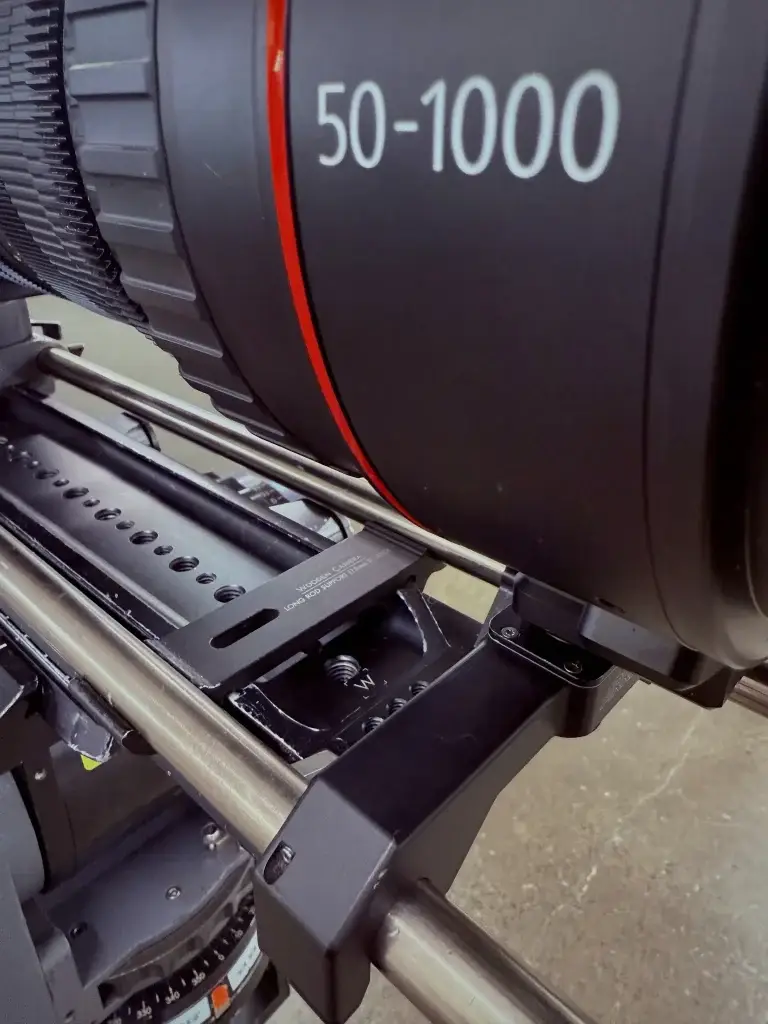
Richard Duquette: Tell me about stabilization. At 1000–1500 mm, how do you keep the image steady enough to be usable—let alone beautiful?
LS: (laughs) First myth to kill: none of these long cine zooms have optical stabilization. Zero. So the challenge is brutal and very real. People don’t appreciate how tiny inputs explode at those focal lengths—a fingertip tap that’d be invisible at 50 mm becomes an earthquake at 800–1000 mm. Yes, you can add a touch of stabilization in post—Resolve can do wonders with a small crop—but that should be your last resort. Even with a perfect setup you’ll sometimes lean on post to polish micro-vibrations. That’s normal.
The obvious place everyone looks is the fluid head, and they’re right—but it’s only half the story. The tripod and the ground you’re standing on matter just as much. Long glass turns your rig into a wind sail; a gust hits the matte box or rain cover and the whole system starts to “breathe.”
For me, the gold standard head is the O’Connor 2575. I’ve also had great results with the Ronford Atlas 50 and Cartoni Maxima. But remember: the best head on a flimsy set of sticks is a waste. You want heavy-duty studio legs with a spreader you can lock hard, spikes that bite, and—if the terrain allows—sandbags on the center spider. You are lucky when you shoot from a Land Rover with a bolt on Michell mount 🙂
Where most folks go wrong is lens support. A single yoke on 15 or 19 mm rods is not enough at 1000 mm—the rods flex. You must add a mid-span brace (long-lens support brace) that ties the rods back to the dovetail/bridge plate, effectively turning the rails into a single, rigid beam. Do that, and the whole front end suddenly goes from “Jack Russell terrier” to rock solid. Also, 18-inch dovetail is the minimum. Honestly, 24″ is better.
Even with all that, there will be days—wind on a ridge line, permafrost harmonics—where you accept that a few seconds need gentle post stabilization. The goal is to minimize what you fix later by building a mechanically rigid, wind-aware system up front.
RD: So how do you control the lens if you’re saying “hands off”? Is that servo any good?
LS: That’s the trick—and it’s what makes the CN20 such a game-changer. The servo unit is phenomenal, and I don’t say that lightly. It’s not some afterthought bolted to a broadcast lens; Canon designed it from the ground up for cinema. The zoom servo is smooth, fully variable, and repeatable—you can feather it so gently it feels like an organic zoom, or you can rip across the full 20× range in a few seconds if the shot demands it.
LS: Focus, however, is another story. The CN20 has only about 180° of focus throw, which is quite short by cinema standards. But that’s intentional—it’s built so you can rack focus fast when needed. In practice, though, you can’t be fiddling with the lens while rolling; any touch introduces shake, and at 1000 mm, that’s instant disaster.
So the workflow changes: I usually shoot at T11, T16, even T22, and we’re often working at 300 yards or more. At those distances and stops you have enough hyperfocal depth to survive without constant pulling. When you do need precision focus, it’s motorized—no way around it.
To be honest, I’ve never relied on Canon’s own focus servo enough to form a strong opinion. It’s designed for broadcast-style controllers, and my muscle memory just isn’t there. The problem is it’s not directly compatible with ARRI or Preston systems, so integrating it into a cinema workflow can be clumsy.
I know this will sound like heresy to some, but I use an ARRI ZMU-3 or ZMU-4 to drive focus in those situations. It’s an odd pairing, but it works for me—the ergonomics and response feel natural after years of using them.
It’s a hybrid workflow: broadcast ergonomics meet cinema discipline. When used right, that servo is buttery smooth—no steps, no lag, no noise. People underestimate it because they assume “servo” means ENG-level performance, but this is a different league. You can run manual cine control when you need critical focus pulls for narrative inserts, then switch to servo control when chasing unpredictable wildlife action.
And honestly, that’s the secret. You have to trust the servo. The moment you start touching the lens, you’re fighting your own stability. The CN20’s grip isn’t just a convenience—it’s a stabilization strategy in itself.
.
RD: Why is this new 20× such a “game changer”? There are some top wildlife shooters using 60–600 mm lenses and getting stunning results. Is the range factor overplayed?
LS: Look, 20× isn’t some revolutionary concept. Back in the 1970s, Angénieux already had the legendary 12–240 mm for 16 mm film—that’s a 20× zoom that shot more documentaries than we can count. Kubrick even used it on Barry Lyndon, extended 2× to make it a 24–480 mm. Broadcast TV cameras of that era had 20× zooms too.
What’s new with the Canon 50–1000 is that it brought that kind of range into the Super 35 world, in a package that’s rigid, compact, and genuinely cinematic. CN20 also inherited the ENG style internal converter and that is not a small thing. at a flip of the switch you reach up a bit further or cover FullFrame in 16:9 mode. its a big deal! That’s the real leap.
Now, how important is that range? From my perspective—it’s everything. If I don’t have the eyes of the animal, I don’t have a story. Sure, I can park on a 1200 mm prime if I’m filming eagles in a nest; that’s perfect for one static setup far from you. But I can’t change that lens mid-sequence, can I?
Take something like baboons. I filmed a troop once—they’d go from the ground to the trees and back down in seconds. One moment they’re fifty yards from the camera, the next they’re deep in the canopy. If you’re on a long prime, you’re done—you can’t keep up. You need width; you need to show behavior, context, movement.
And when you’re filming predators, it becomes absolutely essential. You want to track the hunt—wide enough to follow the chase—but then you want to punch in for the kill. That’s where the 20× earns its place.
Filming birds in flight is where the 20× zoom truly proves its mastery. You need to go wide fast to find the bird against the sky, and then zip in instantly once it’s framed. That’s where the Canon’s servo shines—it can take you from 50 to 1000 mm in about three seconds, with no ramping or lag. When a raptor dives or a flock turns in perfect symmetry, that speed isn’t just convenience—it’s survival.
Of course, there are specific low-light situations where you’d prefer a 400 mm f/2.8 or a 600 mm f/4. But those are isolated shots—one or two scenes per project. The rest? It’s all zoom.
Can you shoot great footage with a Sigma 60–600 mm? Absolutely. Add a 1.4× extender and you’re in the 84–840 mm range for about $3,000, with autofocus and image stabilization. But if you’re racing professionally—if you’re betting on a once-in-a-lifetime moment—you don’t pick a Subaru over a Ferrari.
The 20× zoom gives you command over so many unpredictable situations, and in wildlife work—where the success rate is painfully low—every single chance matters.
RD: Let’s talk about cameras. Pairing a 50–1000 mm lens isn’t a casual choice—you’re dealing with weight, balance, and resolution demands. What camera systems make sense for this lens today, and how do you decide what to bring into the field?
LS: That’s a tricky question, and there’s really no single right answer. For me, it’s simple—ARRI all the way. But in fairness, the world of natural history is mostly RED territory. Everyone has their own workflow, and mine comes from a narrative background; I transitioned from shooting 35 mm film into digital with the Sony F55—and honestly, that was a dreaded experience.
My first real digital setup for wildlife was a pair of RED Heliums, and as always, you use what you have. I shot exclusively on Heliums for a good two years, and for a time that setup was the gold standard. Even today, Helium or the newer Rhino sensor are probably the best way to extract maximum resolution from the CN20. When you’re in 8 K S35 mode—and if I’m not mistaken, around 5.5 K in Super 16 crop—the CN20 effectively becomes a 1800 mm lens.
But for me personally, RED has its limits—mainly in camera build. The lack of internal ND is a nightmare. If you’re shooting raptors, you’re constantly juggling exposure: swapping Revolva cartridges in the rain, dust getting in, fumbling with filters, and dealing with a lens mount that isn’t really designed to support something as front-heavy as the CN20. EVF optiso are sub par and you cant shoot nature without EVF or with a bad viewfinder. Then there is low base ISO and so on.
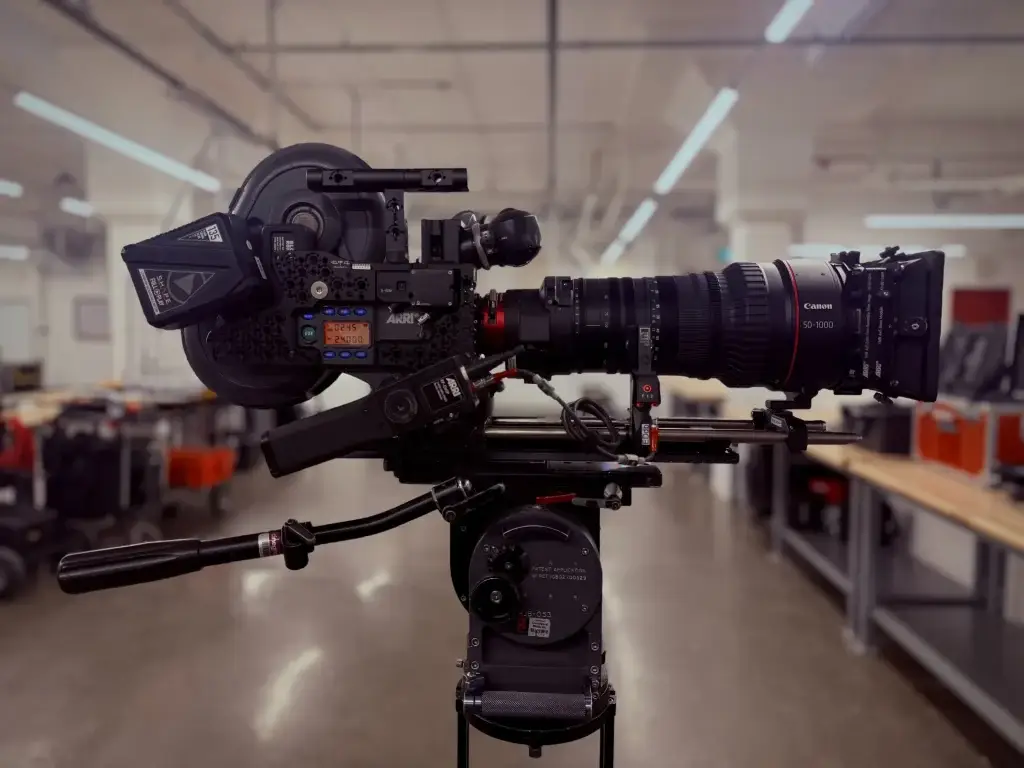
In an ideal world, I’d go with an ARRI Alexa 35 (or the Alexa 35 XTreme, even better), paired with the Canon CN20, ARRI ZMU-4 hand unit with cforce motors for focus, on an O’Connor 2575 head with heavy-duty sticks, custom rigging, plate-style lens support, and a long dovetail. That setup feels like home—balanced, solid, predictable.
Everything beyond that—power solutions, weather protection, rigging accessories—depends on the assignment. The philosophy is simple: less is more. Both the Alexa 35 and Venice 2 can be built surprisingly compact for fieldwork if you respect that principle—no over-engineering, just reliability and balance.
LS (highlight):
*“Three things changed wildlife cinematography forever: pre-recording, high-speed slow motion, and accessible drones.
Pre-recording—or cache recording—gave us a time buffer, sometimes twenty seconds or more. Instead of endlessly rolling and waiting for something to happen, we can now constantly ‘record’ and simply save the moment when it does.
High frame rates—anything above 100 fps—opened new ways of seeing animal behavior. Back in the film era, the 16 mm ARRI SR3 HS could only shoot one minute and forty seconds on a 400-foot roll. Slow motion was precious, expensive, and rare. Today we can shoot all day at 240 fps, with pre-record running the whole time.
And then there are drones—once pure science fiction, now indispensable tools. They’ve changed how we perceive movement, space, and habitat. Together, these three innovations reshaped not only how we film wildlife, but how we understand it.”*
RD: Is there any real application for the CN20 outside of natural history work? Logical question for you—have you ever shot 35 mm film with this lens? Will it clear the mirror on a film camera?
LS: For sure, it’ll clear the mirror shutter on a 35 mm film camera. The rear end of the CN20 is identical to most cine 10× zooms, so there’s no risk of collision. Optically, it’s absolutely up to the task—sharp enough to hold its own even on film. In fact, if you compare it to the zooms that ruled Hollywood in the 1970s and ’80s, the CN20 would outperform nearly all of them in resolution and contrast and low CA.
Where things get tricky is exposure. The 50–1000 is a slow lens, and shooting around T11 on film can be demanding. Forget low-light or dusk—this zoom wants daylight. But for daytime exteriors, it’s fine, and realistically, you’d never use it indoors anyway.
We’ve talked about doing some tests on Super 16, though, and I think that could be a hidden gem. The effective reach would be monstrous, and the grain structure might actually complement the lens’s sharpness beautifully.
Beyond wildlife, I know TV , sports and broadcast crews use the CN20 a lot. The lens has also become popular with automotive cinematographers—I’ve seen some stunning high-end car commercials shot with it. The ability to go from a wide beauty angle to an extreme tele in seconds gives directors incredible flexibility for dynamic vehicle work.
That said, we should be realistic when evaluating the CN20. There are plenty of zooms that will outperform it in speed, clarity, or character—they just won’t give you a 20× range. Fujinon, for example, built an ultimate 40× box zoom for Super 35 that’s almost 60 lb and costs around $150,000. Different beast entirely.
The 50–1000 Canon is the king of its own dominion—purpose-built, rugged, and unmatched in versatility. It’s not the sharpest or the fastest lens on the planet, but in the environment it was designed for, it’s the right tool for the job, and it’s worth getting to know a tool that powerful.
RD: So to wrap it up—what’s the takeaway here?
LS: The takeaway is simple: we’re lucky to have this tool, and even luckier to have it in full working and vertically integrated system . At Cineground, we don’t just have a CN20 on the shelf—we’ve built an entire turnkey ecosystem around it. That means a ready-to-go, production-tested solution for any wildlife, nature, or documentary assignment.
It’s not just about the lens. It’s about the complete rig, the heads, the power, the camera integration, and the support gear—everything dialed in and tested in the field. You can walk in with your project brief and walk out with a fully prepped system capable of shooting from the Arctic to the Sahara.
The Canon 50–1000 mm may be a niche tool, but in the right hands—and with the right setup—it’s one of the most expressive lenses ever built. It bridges the worlds of cinema and natural history, where patience meets precision, and preparation meets instinct.
At Cineground, we take pride in keeping that tradition alive. We’re here not only to rent gear but to enable stories—the kind that demand endurance, control, and a deep respect for the craft. The CN20 might be the “
At Film Solutions, we’re proud to stand alongside Cineground in offering international filmmakers a true, end-to-end solution for wildlife and nature documentary production in Canada. Through our partnership we provide not just exceptional optics like the Canon CN20 50–1000 mm, but an entire suite of high-end cinema tools—ARRI Alexa 35, Sony Venice 2, RED Raptor XL, RED Helium Monochrome, along with cinema zooms, rain deflectors, and underwater housings.
For remote and demanding assignments, Film Solutions offers a fully rigged Mercedes Sprinter 4×4 camera van—a self-contained mobile production platform powered by solar energy and equipped with satellite communication. Designed from field experience and refined through years of client feedback, it enables crews to stay mobile, autonomous, and productive no matter how remote the location.
In addition, Film Solutions can supply all essential outdoor and survival gear—wildlife blinds, camouflage shelters, camping kits, protective clothing, and specialized equipment crucial for filming in extreme conditions. Every item is field-proven and curated for durability and performance.
Whether you’re filming along the rugged coasts of Atlantic Canada, exploring the national parks of Alberta, or venturing deep into the Northern Territories, we can get you there—and keep you shooting at the highest technical standards.
Our mission is simple: to make sure your crew, your cameras, and your vision are supported by the most capable tools available—so you can focus on what truly matters: capturing the untamed beauty of the wild.